Illustrated in Victorian mourning portrait, black and grey oils style
The Widow of County Durham
A Victorian Tale About Unfortunate Luck in One Household
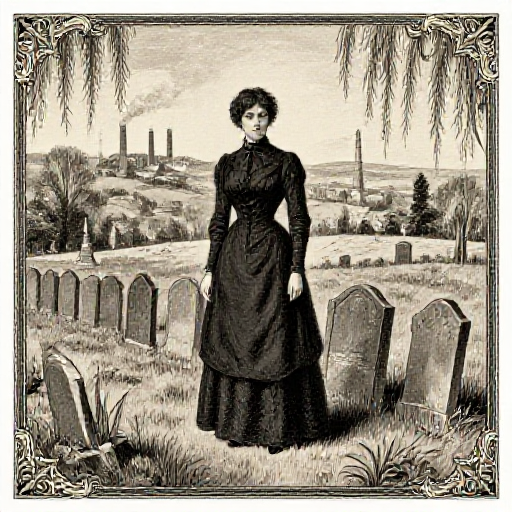
In Victorian England, life was short and death was common. Babies died of fevers. Husbands died of toil. Insurance companies were quite new and nobody had worked out yet how to be suspicious. Into this world came Mary Ann Cotton: a handsome woman, a good cook, and a person around whom death happened with remarkable regularity.
Mary Ann Cotton lived in an era when high mortality rates helped mask her crimes. Life insurance was a relatively new concept in working-class England.
Mary Ann had three husbands. They all died of gastric fever. She had twelve children of her own. Most of them died of gastric fever. She had stepchildren. They died of gastric fever. She had a lover whose wife was in the way. The wife died of gastric fever. 'It's going around,' said Mary Ann. It was, in a way. It was in the tea.
Cotton is suspected of killing up to 21 people, including three husbands, a lover, her mother, and many of her own children, primarily with arsenic-laced tea.
The local doctor was not very suspicious. He signed the death certificates. He signed more of them. He signed a remarkable number for one address. 'Gastric fever,' he wrote, each time. He was not a curious man. Curiosity was not considered a medical virtue in 1860s County Durham.
Dr. Kilburn initially attributed the deaths to natural causes. His lack of suspicion allowed Cotton to operate for nearly twenty years.
Mary Ann's last stepson, Charles, was in the way of her newest plans. A neighbor heard her say it would be better if Charles were gone. Charles died. The neighbor mentioned what he'd heard. The doctor, finally curious, had a look at Charles. And there was the arsenic. It had been in all of them. All along.
Charles Edward Cotton's death in 1872 prompted an inquest. Arsenic was detected, and previous victims were exhumed with similar findings.
Mary Ann Cotton was the first female serial killer to be recognized as such by a modern press. The newspapers called her a monster. Children sang songs about her in the streets: 'Mary Ann Cotton, she's dead and she's rotten.' She was hanged in Durham in 1873. The hangman was unfortunately hasty and things did not go smoothly. But then, they rarely had around Mary Ann.
Cotton was executed on March 24, 1873. The hanging was botched, prolonging her death. She remains one of Britain's most prolific serial killers.